Let’s talk about sugar!
We all like sweet things. Cookies, milkshakes, pies, sweet tea, sweetened coffee, the list is endless! Let’s explore our sugar habit just a little.
Some interesting facts about sugar consumption in the US.
What happens to all that extra sugar??
Per the American Heart Association, “It all comes down to how fast sugars get absorbed. For example, your body spends more time digesting an apple than regular soda. The apple contains fiber, so the natural sugar absorbs more slowly. The added sugar in soda, however, hits your system all at once, absorbing sugar much more quickly. A 12-ounce can of soda contains 10 teaspoons (42 grams) of added sugar — nearly double the recommended amount a day for women and more than the total daily amount for men.”
Eating too much sugar ”sets off a reaction that can result in diabetes and other conditions. As sugar is digested, the blood glucose level increases. To regulate it, the pancreas pumps out insulin, which lowers glucose in the blood. The more sugar consumed, the harder the pancreas has to work.”
What to look for while grocery shopping?
Directly from the American Heart Association website: There’s a lot of confusing information out there. Studies show that 68% of shoppers come across conflicting nutritional data on social media and 60% of them doubt the choices they are making for their families due to conflicting information.
It’s tempting to look to alternative sugars, which often can be perceived as healthier choices than plain white sugar. Don’t be fooled. Added sugar is added sugar no matter what it is called. Check out the ingredients lists for these added sugars:
Food manufacturers are now required to list the amount of added sugars on the Nutrition Facts label in grams and as a percentage of daily value. A recent analysis found that this labeling could potentially prevent nearly 1 million cases of cardiovascular disease and Type 2 diabetes over the next two decades. Listing the total amount of added sugars means that consumers can easily determine how much added sugar is in a food or beverage. This information helps shoppers make smart choices.
The remedy is straightforward — consume less sugar to reduce the risks — but difficult because added sugar is everywhere. And it’s delicious.
Be mindful of what you’re eating and how you’re shopping. Here are some tips:
All this information and more is found on the American Heart Association website. www.heart.com
Eat smart, drink smart, live better!!
Access the survey, please use the following link: https://cnha.mgghnv.org

Let’s talk about Carbon Monoxide. This information is directly from CDC. Please go to Centers for Disease Control for more information.
https://www.cdc.gov/carbon-monoxide/about/index.html
Carbon monoxide (CO) is an odorless, colorless gas that kills without warning. It claims the lives of hundreds of people every year and makes thousands more ill.
Many household items including gas- and oil-burning furnaces, portable generators, and charcoal grills produce this poison gas.
Symptoms:
The most common symptoms of CO poisoning are headache, dizziness, weakness, upset stomach, vomiting, chest pain, and confusion. CO symptoms are often described as “flu-like.”
If you breathe in a lot of CO, it can make you pass out or kill you. People who are sleeping or drunk can die from CO poisoning before they have symptoms.
Risk factors:
Everyone is at risk for CO poisoning. Infants, the elderly, and people with chronic heart disease, anemia, or breathing problems are more likely to get sick from CO.
Each year, more than 400 Americans die from unintentional CO poisoning not linked to fires, more than 100,000 visit the emergency room, and more than 14,000 are hospitalized.
Reducing risk:
CO is found in fumes produced any time you burn fuel in cars or trucks, small engines, stoves, lanterns, grills, fireplaces, gas ranges, or furnaces. CO can build up indoors and poison people and animals who breathe it. However, you can reduce your risk of CO poisoning with a few small steps.
CO Detectors:
Install battery-operated or battery back-up CO detectors near every sleeping area in your home.
Check CO detector batteries when you change the time on your clocks each spring and fall to be sure they are functioning properly.
Consider buying a detector with a digital readout. This type of detector can tell you the highest level of CO concentration in your home, in addition to sounding an alarm.
Replace your CO detector following the manufacturer's instructions or every 5 years. Set a reminder on your smartphone or other device calendar when you purchase and install the detector. (Carol’s note, CO detectors are relatively inexpensive and can save your life. Hardware stores, Walmart, Amazon all carry them.)
Oil and gas furnaces and other household appliances:
Have your heating system, water heater, and any other gas, oil, or coal burning appliances serviced by a qualified technician every year.
Make sure your gas appliances are vented properly. Horizontal vent pipes for appliances, such as a water heater, should go up slightly as they go toward outdoors, as shown below. This prevents CO from leaking if the joints or pipes aren't fitted tightly.
When you buy gas equipment, buy only equipment carrying the seal of a national testing agency, such as Underwriters' Laboratories.
If you smell an odor from your gas refrigerator, have an expert service it. An odor from your gas refrigerator can mean it could be leaking CO.
Never heat your house with a gas oven. Don't cook or burn anything on a stove or fireplace that isn't vented.

Chimneys, charcoal, and portable appliances:
Have your chimney checked or cleaned every year. Chimneys can be blocked by debris, which can cause CO to build up inside your home or cabin.
Never burn charcoal indoors. Burning charcoal - red, gray, black, or white - gives off CO.
Never use a portable gas camp stove indoors. Do not use portable flameless chemical heaters indoors.
Portable generators:
Never use a generator inside your home or garage, even if doors and windows are open.
Only use generators outside, more than 20 feet away from any windows, doors, and vents.
When using a generator, use a battery-powered or battery backup CO detector in your home.
Automobile:
Have a mechanic check the exhaust system of your car or truck every year. A small leak in the exhaust system can lead to a buildup of CO inside the car.
Never run your car or truck inside a garage that is attached to a house, even with the garage door open. Always open the door to a detached garage to let in fresh air when you run a car or truck inside.
If you drive a car or SUV with a tailgate, when you open the tailgate open the vents or windows to make sure air is moving through. If only the tailgate is open, CO from the exhaust will be pulled into the car or SUV.
This information is taken directly from the CDC website: Click here - For more information.
Signs and symptoms:
A person usually develops symptoms 12 to 48 hours after being exposed to norovirus.
Symptoms include: Diarrhea, vomiting, nausea, stomach pain, fever, headache, and body aches.
Dehydration:
If you have norovirus illness, you can feel extremely ill, and vomit or have diarrhea many times a day. This can lead to dehydration (loss of body fluids), especially in young children, older adults, and people with other illnesses. Symptoms of dehydration include:
Decreased urination, Dry mouth and throat, Feeling dizzy when standing up. Crying with few or no tears, Unusual sleepiness or fussiness
Anyone can get infected and sick with norovirus and people of all ages get infected during norovirus outbreaks.
Anyone who consumes raw shellfish is at risk of contracting norovirus. Children younger than 5 years old, older adults, and people with weakened immune systems are more likely to develop severe infections.
How it spreads:
Norovirus spreads very easily and quickly in different ways. You can get norovirus by:
Having direct contact with someone with norovirus, like caring for them, sharing food or eating utensils with them, or eating food handled by them.
Eating food or drinking liquids that are contaminated with norovirus.
Touching contaminated objects or surfaces and then putting your unwashed fingers in your mouth.
You can still spread norovirus for 2 weeks or more after you feel better.
Prevention:
Norovirus is very contagious, but you can take steps to protect yourself and others, including:
Taken directly from my favorite information site, the Centers for Disease Control (CDC). All credit to the authors and the publication.
Influenza (flu) is a potentially serious disease that can lead to hospitalization and sometimes even death. Every flu season is different, and flu can affect people differently, but during typical flu seasons, millions of people get flu, hundreds of thousands of people are hospitalized and thousands to tens of thousands of people die from flu-related causes. Flu can mean a few days of feeling bad and missing work, school, or family events, or it can result in more serious illness. Complications of flu can include bacterial pneumonia, ear infections, sinus infections and worsening of chronic medical conditions, such as congestive heart failure, asthma, or diabetes. An annual seasonal flu vaccine is the best way to help reduce the risk of getting flu and any of its potentially serious complications. Vaccination has been shown to have many benefits including reducing the risk of flu illnesses, hospitalizations and even the risk of flu-related death. While some people who get a flu vaccine may still get sick with influenza, flu vaccination has been shown in several studies to reduce severity of illness.
The tips and resources below will help you learn about actions you can take to protect yourself and others from flu and help stop the spread of germs.
After these two criteria are met, there are some additional precautions that can be taken to protect others from respiratory illness. More information is available at About Preventing Spread of Respiratory Viruses When You’re Sick.
From Immunize.org
Communicating the Benefits of Influenza Vaccination
Flu vaccination is the best way to prevent flu and its complications. Everyone age 6 months and older is recommended to get a yearly flu vaccine. This can markedly lower the risk of influenza-related illness, hospitalization, and death. Take advantage of every opportunity to make a strong recommendation for flu vaccine and other vaccines your patients may need, such as COVID-19, RSV, and pneumococcal vaccines. Flu vaccine may be given at the same time as other vaccines.
There are several places to get a flu shot:
Safeway Pharmacy accepts almost all insurance plans for vaccinations.
The Central Nevada Health District is putting on a flu shot clinic in Hawthorne, at the Mineral County Fire Station on October 30 from 4:00PM to 7:00PM, this will be a drive-thru event. There will be only the regular dose, none of the high dose at this event.
For people over the age of 65, ask your health care provider if the High-Dose Flu Vaccine is the right choice for you.
Reference: CDC and Immunize.org
Warm weather is already being felt around the state. In Nevada, it doesn’t take long for the weather to become hot! There are several ways to make your days and nights more comfortable while indoors. Swamp coolers are pretty effective in dry climates, air is pulled through wet pads and cooled, the cooled air is circulated into the home. Air conditioning is a wonderful thing. Set the temperature you desire, turn the unit on, and bask in the cool air.
What about outside when the weather is hot, especially during the daytime when the sun is beating down on us? Hot weather is not just an annoyance, it can be harmful or deadly if precautions are not taken. Let’s talk about Heat Related Emergencies.
We are going to go by what the experts at CDC have to say. The CDC addresses five heat related illnesses:
Heat stroke is a TRUE MEDICAL EMERGENCY!!
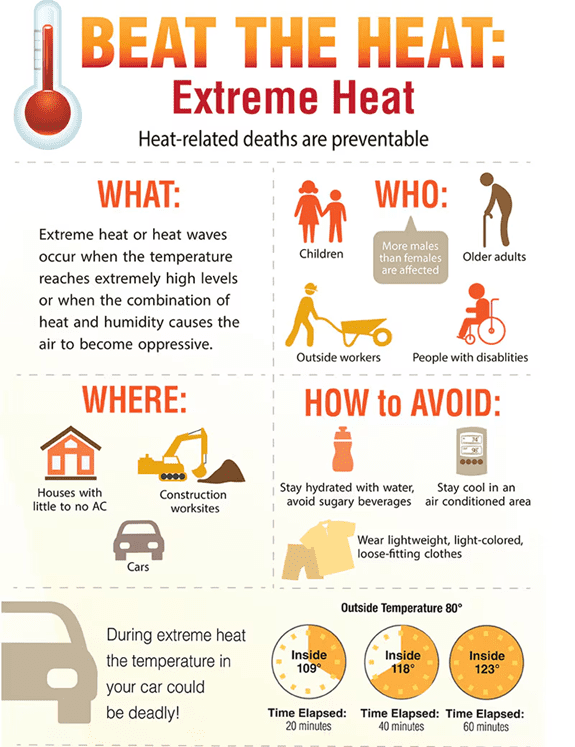
Extreme heat is defined as summertime temperatures that are much hotter and/or humid than average. Because some places are hotter than others, this depends on what’s considered average for a particular location at that time of year. Humid and muggy conditions can make it seem hotter than it really is.
Know the signs and symptoms of heat-related illnesses.
Heat-related illnesses, like heat exhaustion or heat stroke, happen when the body is not able to properly cool itself. While the body normally cools itself by sweating, during extreme heat, this might not be enough. In these cases, a person's body temperature rises faster than it can cool itself down. This can cause damage to the brain and other vital organs.
Some factors that might increase your risk of developing a heat-related illness include:
The American Stroke Association wants everyone to know that May is American Stroke Month. Let’s talk about strokes!
Stroke is a disease that affects the arteries leading to and within the brain. It is the Number 5 cause of death and a leading cause of disability in the United States.
A stroke occurs when a blood vessel that carries oxygen and nutrients to the brain is either blocked by a clot or bursts (or ruptures). When that happens, part of the brain cannot get the blood (and oxygen) it needs, so it and brain cells die.
What are the types of stroke?
Stroke can be caused either by a clot obstructing the flow of blood to the brain (called an ischemic stroke) or by a blood vessel rupturing and preventing blood flow to the brain (called a;hemorrhagic stroke). A TIA (transient ischemic attack), or "mini stroke", is caused by a temporary clot.
Stroke Symptoms
By learning and sharing the F.A.S.T. warning signs, you just might save a life from stroke.
Call 911 if these signs are present:
F.A.S.T. Warning Signs
Use the letters in F.A.S.T. to spot a Stroke
Other Stroke Symptoms
Watch for Sudden:
The F.A.S.T. Experience
In this fun and interactive environment, you’ll learn what the warning signs of stroke might look, feel and/or sound like.
Play the games https://www.stroke.org/en/fast-experience
For more information about strokes, stroke symptoms, outcomes, etc., visit The American Stroke Association at:
You might save a life!
Hello everyone,
Some old diseases are making their way back into mainstream America and can have devastating results. Many diseases are considered eradicated after many years of intense vaccine therapy and education. Heard of any Smallpox in your neighborhood lately? No, and you won’t. How about Polio? We all have a much older relative who had polio as a child and either recovered or passed away. No cases of Polio lately. Thanks to science and faith in vaccine safety. These diseases are safely tucked away from us.
I want to talk about measles.
Here are some nice dry statistics directly from the CDC.
History of Measles Cases
Measles was officially eliminated from the United States in 2000, meaning there is no measles spreading within the country and new cases are only found when someone contracts measles abroad and returns to the country. Achieving measles elimination status in the U.S. was a historic public health achievement.
The Measles, Mumps, Rubella (MMR) vaccine is very safe and effective. When more than 95% of people in a community are vaccinated (coverage >95%), most people are protected through community immunity (herd immunity). However, vaccination coverage among U.S. kindergartners has decreased from 95.2% during the 2019–2020 school year to 93.1% in the 2022–2023 school year, leaving approximately 250,000 kindergartners at risk each year over the last three years. To dive into vaccine coverage data for MMR, visit VaxView | CDC.
As of April 4, 2024, a total of 113 measles cases were reported by 18 jurisdictions: Arizona, California, Florida, Georgia, Illinois, Indiana, Louisiana, Maryland, Michigan, Minnesota, Missouri, New Jersey, New York City, New York State, Ohio, Pennsylvania, Virginia, and Washington.
There have been 7 outbreaks (defined as 3 or more related cases) reported in 2024, and 73% of cases (83 of 113) are outbreak-associated. For comparison, 4 outbreaks were reported during 2023 and 48% of cases (28 of 58) were outbreak-associated.
The 113 cases in the US by age:
Under 5 years: 56 (50%),
5-19 years: 26 (23%)
20+ years: 31 (27%)
The 113 cases in the US by vaccination status:
Unvaccinated or Unknown: 83%
One MMR dose: 12%
Two MMR doses: 5%
The hospitalization rate of the 113 cases:
58% of cases hospitalized (65 of 113 cases) for isolation or for management of measles complications.
Percent of Age Group Hospitalized:
Under 5 years: 66% (37 of 56)
5-19 years: 35% (9 of 26)
20+ years: 61% (19 of 31)
7 – 14 days after a measles infection: first symptoms show
Measles isn’t just a little rash. Measles can be dangerous, especially for babies and young children. Measles typically begins with
No cases of measles have been reported in Nevada at this time.
For more information about measles, vaccinations, severity of cases and many other diseases, visit the CDC.gov website.
As you may have noticed, Covid-19 is back. Many people in our community have already had it and it’s not fun. We all have to do our part to keep our vulnerable friends, family members, co-workers, and immunocompromised people safe (chemo patients, bone marrow transplant patients, diabetics, etc.). Symptoms are, but not confined to: Headache, Sore Throat, Cough, Congestion, Sneezing, Fever & Chills, and Fatigue. Some people have gastric symptoms such as Nausea, Vomiting and Diarrhea. Food may not taste right or there could be a loss of taste or smell.
Home tests are available at Safeway, Mt. Grant General Hospital in the reception area or the Safety office. In some cases, symptoms are present for several days before resulting in a positive Covid test.
If you wish to have a Covid-19 vaccination, talk with our clinic, Safeway (or other) pharmacies, or the Central Nevada Health district.
Please wash your hands frequently or use hand sanitizer. Stay 6 feet away from other people. Stay home if you are sick, if you can’t stay home, please consider wearing a mask. Masks are a simple and effective way to protect yourself and others. Your health is important to us.
Hello everyone.
The subject of smoking cigarettes is near and dear to my heart. Smoking is now called “Tobacco Use Disorder”, and it is very addictive. Quitting smoking is hard but it can be done. Your provider has many tools in their toolbox to help.
Our friends at the CDC have lots of resources. The American Lung Association has programs to help you get started and stay the course. The State of Nevada also has options to offer. Let’s talk about quitting!
The American Lung association has much to say about stopping smoking:
Tobacco use is the leading cause of preventable death and disease in the U.S., making it critically important that prevention and cessation programs are available to help people break their tobacco addiction for good. The American Lung Association supports funding for federal, state, and local programs that help tobacco users quit and prevent kids and adults from starting to use tobacco.
We also support policies that give smokers easy access to all treatments proven effective to help them quit. Medicaid expansion and most private health insurance plans are required to cover a comprehensive tobacco cessation benefit for plan members, including all seven medications and three types of counseling recommended by the U.S. Public Health Service. To help smokers quit, the Lung Association encourages all health plans to cover a comprehensive, barrier-free cessation benefit.
The Lung Association is a leader in the area of tobacco cessation policy at the federal, state, and local levels. Since 2007, our Tobacco Cessation Policy Project has provided up-to-date information and tools for advocates, policymakers, media, and smokers.
To start your journey to being smoke-free, go to https://www.lung.org/
The Centers for Disease Control, CDC, also wants to help you to stop smoking:
Trying to quit smoking feels different for each person, but almost everyone will have some symptoms of nicotine withdrawal. When you stop, your body and brain have to get used to not having nicotine. This can be uncomfortable, but nicotine withdrawal can’t hurt you – unless you give in and have a cigarette!
Over time, withdrawal symptoms will fade as long as you stay smokefree.
1. Having urges or cravings to smoke

Almost everyone who smokes regularly has cravings or urges to smoke when they quit. They may be mild or can sometimes feel overwhelming. Figuring out how to deal with cravings is one of the most important things you can do to stay successful.
Ways to manage: There are LOTS of things you can do to make urges and cravings less of a problem. Quit-smoking medicines can help a lot, and so can other quitting tips. Cravings can be triggered by things that make you think about smoking—like people you smoked with, a place you often smoked, or things you used to do while smoking like having a cup of coffee. Even a thought or a feeling can trigger a craving. But other thoughts can help you get through a craving, like remembering why you are quitting. Remember that you never have to give in to a craving, and that it will always pass.
2. Feeling irritated, grouchy, or upset
It is very common to feel irritated or grouchy when you quit. Even many people who have never smoked know this is part of quitting. Knowing this is normal can be helpful.
Ways to manage: Remind yourself that you likely feel this way because your body is getting used to being without nicotine. Take a few deep breaths and remind yourself why you’re quitting.

Feeling jumpy or restless during the first days or weeks after quitting is normal. Just like your mind gets irritated without nicotine at first, the rest of your body can, too.
Ways to manage: Doing some physical activity can help shake loose your jumpiness. Get up and walk around for a bit if you feel restless. Try cutting back on coffee, tea, and other caffeinated drinks. When you quit smoking, caffeine lasts longer in your body.
4. Having a hard time concentrating
You may notice that it is harder to concentrate in the first days after you quit—this is very common.
Ways to manage: Try to cut yourself some slack, especially in the first days after you quit. Try to limit activities that require strong concentration if you can.
5. Having trouble sleeping

It’s common to have some trouble sleeping when you first quit smoking. This will get better, but if it is bothering you, talk with your healthcare provider to get help. If you become exhausted from poor sleep, this can make it harder to stay quit.
Ways to manage:
6. Feeling hungrier or gaining weight
It’s normal for your appetite to increase some when you quit. And your body may not burn calories quite as fast. You may also eat more because of the stress of quitting or to have something to do with your hands and mouth. Food may even be more enjoyable because your senses of smell and taste are not being dulled by all that smoke!
Ways to manage: While some people may gain weight after they quit, it’s important for your health to quit sooner than later. Below are a few simple things you can do to help control weight gain after quitting. The bonus is that these things will help you build healthy behaviors for a lifetime of being smokefree!
If you are worried about gaining weight, a quit coach can help you with other quitting tips, or you can talk with your healthcare provider for help.
7. Feeling anxious, sad, or depressed

People who smoke are more likely to have anxiety or depression than people who don’t smoke. Some people feel mood changes for a short time after they quit smoking. Watch for this, especially if you’ve ever had anxiety or depression.
For some people, smoking may seem like it helps with anxiety or depression, but don’t be tricked. Smoking might make you feel better in the short-term, but that’s because the nicotine in cigarettes stops the discomfort of withdrawal, not because it is helping with anxiety or depression. There are much better ways to deal with withdrawal symptoms and mood changes than returning to smoking! The good news is that once people have been smoke-free for a few months, their anxiety and depression levels are often lower than when they were smoking.
Ways to manage:
What if feelings of depression get worse, or don’t get better? You should get help. Talk to your healthcare provider, call the quitline (1-800-QUIT-NOW), or seek appropriate emergency help.
The State of Nevada also has resources to help:
Free services and medications available to help Nevada smokers quit
Nevada Tobacco Quitline 1-800-QUIT-NOW
Carson City July 29, 2020
Smokers, other tobacco users, including those who use e-cigarettes and vaping devices can get free phone tobacco cessation counseling and resources to help them quit.
Resources include medications made available by the Nevada Division of Public and Behavioral Health. Medications include gum and/or patches, lozenges, inhalers, and/or nasal sprays; supplies depend on availability and eligibility.
The Centers for Disease Control and Prevention (CDC) Tips From Former Smokers national tobacco education campaign is encouraging smokers to call 1-800-QUIT-NOW (800-784-8669) for help getting medications and counseling at no cost. Callers must enroll in the Nevada Tobacco Quitline to work with a trained coach and be medically eligible to receive free medication.
People who smoke cigarettes can and do quit. In fact, today there are more former smokers than current smokers in the United States. According to the CDC (2018), about 68%of adult cigarette smokers want to quit and research shows quitting completely at any age has health benefits.
Stopping smoking:
• Lowers your risk of developing lung, throat, bladder, and cervical cancers.
• Reduces your risk of heart disease and stroke.
• Reduces the risk of developing complications in people with diabetes.
• Reduces respiratory symptoms, such as coughing, wheezing, and shortness of breath.
• Reduces risk of developing lung diseases such as chronic obstructive pulmonary disease.
• Reduces risk of infertility in women of childbearing age. Women who stop smoking during pregnancy also reduce their risk of having a low birth weight baby.
• Lowers health risks associated with secondhand smoke.
Quitline counseling and medication, including gum, patches, lozenges, inhalers, and/or nasal sprays are all effective tools in helping smokers quit. Using them together is more effective than using any other method alone. Medications help smokers quit by decreasing the urge to smoke and other withdrawal symptoms while quitting.
Data shows approximately one out of every six of Nevada adults smoke. Smoking is the leading preventable cause of disease and death in the United States. Smoking kills 480,000 Americans each year and is responsible for diseases affecting another 16 million.
Additional information on quitting tobacco is available at https://nevada.quitlogix.org or cdc.gov/tips.
Everyone who smokes has a reason to quit:
Whatever the reason, use that to take control of your smoking. As you can see, there are resources to keep you motivated and on track. Help yourself have a wonderful future free of tobacco. Call your provider today to make an appointment to talk about quitting. Go to lung.org and take their help. Go to the Nevada site https://nevada.quitlogix.org and get some answers. This could be the best thing you do for yourself!!
Holiday Depression
As my Facebook loves to remind me, lots of us are trading our normal, everyday depression and anxiety for a special holiday depression and anxiety.
Holidays can be wonderful with family, tons of food, decorations, and love. Not everyone enjoys a bright, happy holiday. I want to talk about holiday stress. The experts at WebMD have lots to say about holiday depression.
Holiday Depression and Stress
Written by WebMD Editorial Contributors
The holiday season for most people is a fun time of the year filled with parties, celebrations, and social gatherings with family and friends. For many people, it is a time filled with sadness, self-reflection, loneliness, and anxiety.
What causes holiday blues?
Sadness is a truly personal feeling. What makes one person feel sad may not affect another person. Typical sources of holiday sadness include:
Balancing the demands of shopping, parties, family obligations, and house guests may contribute to feelings of being overwhelmed and increased tension. People who do not view themselves as depressed may develop stress responses, such as:
Additional resources include:
LOCAL
Rural Clinics – 1000 C St. Suite A2 – Mon-Fri 8:00 am-5:00 pm
Thrive – 1000 C St., Suite A1 - Mon-Fri 9:00 am-6:00 pm
Community Chest – Mon-Fri 9:00 am-2:00 pm
OUTREACH
Dial 988 from ANY phone – Suicide & Crisis Lifeline – 24 hour support
NAMI Nevada – 775-241-4212 – 24 hour support
Mobile Crisis Response Team Hotline – 775-688-1670 – For Children under the age of 18 and Families
Nevada Teen Text Line – 775-296-8336
Adult Crisis Text Line – 748748
We hope this helps!